Frequently Asked Questions
Does ExtendFS support Apple Silicon?
Yes, both Intel and Apple Silicon (M1/M2/M3/M4/M5 etc.) Macs are supported, as long as the version of macOS used is 15.6 or later. Unlike older options, you do not need to change your system security settings in recovery mode.
What's the difference between the version available on GitHub and the Mac App Store version?
There's no code differences. They're the same build with exactly the same functionality. The only difference is that the App Store can handle automatic updates for you if you want (which, depending on your perspective, might be a benefit or a drawback). If you want to support this project, you can purchase the App Store version, but otherwise the app is free.
Why is macOS 15.6 required?
FSKit first released in macOS 15.4, so ExtendFS can't support any version of macOS below that. macOS 15.4 and 15.5 had significant issues in FSKit that made it much more complicated to mount disks (FB17772372), and since any device that can support macOS 15.4 can also support macOS 15.6, I set the minimum version to 15.6 to make things more simple.
I have a bug or question, where can I go to ask about that?
Please see the support document for information about that.
I'd like to support you, but I want to contribute an amount different from the App Store price and/or I don't want to use the App Store. Is there another way to support this project?
First, please be aware that ExtendFS is free on GitHub. Monetary support is never expected, and I cannot provide special treatment or support if you do donate money. However, if you still would like to, thank you! My GitHub Sponsors profile allows you to contribute an amount of your choosing, either monthly or one-time.
Will read-write support ever come to ExtendFS?
Maybe...
Probably not.
Will support for other Linux filesystems (like Btrfs) ever come to ExtendFS?
I'd say read-only support for other filesystems is slightly more of a possibility than read-write support in general, although the answer is still "probably not."
In the immediate future, though, I can say this is almost definitely a "no," at least for the specific case of Btrfs. My understanding is that Btrfs has subvolumes as a key feature, as in one block device might present multiple volumes to the system. However, the current version of FSKit only supports what Apple calls "unary file systems," which essentially means one block device (resource) presents one volume. Apple has indicated that future versions of FSKit will support more complex file systems, but it is not there yet.
What are the FB number(s) that have been appearing in this document and other places on the site?
Those are Apple feedback numbers for various bugs I filed against FSKit. You unfortunately can't see them, but they're mostly for my own reference (or to reference by an Apple employee, if they happen to come across this).
Other tools like ext4fuse exist, why did you make this?
A few reasons:
-
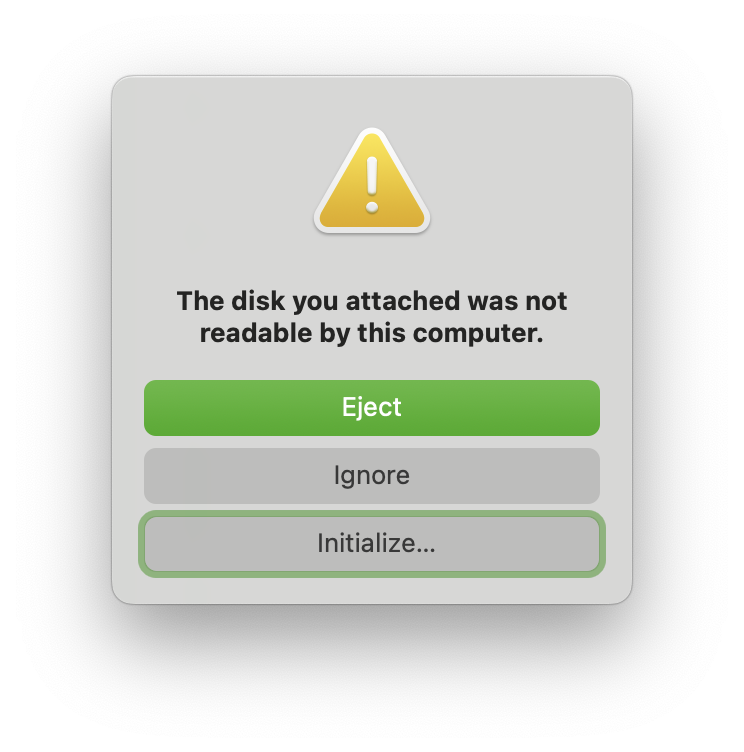
Most other tools don't integrate very well with the system's frameworks, like Disk Arbitration (for disk automounting). I don't like seeing this:
Implementations like macFUSE are fairly difficult to install on Apple Silicon machines because installing kernel extensions requires reducing your system security level in recovery mode. (This is less of a problem as newer versions of macFUSE do support FSKit and alternatives like FUSE-T exist, although the kernel extension is still used by default.)
I found it fun and it was a cool learning opportunity. FSKit is new and fairly uncharted territory so it's pretty interesting to try to make something useful with it.
You have a sick sense of fun.
That's not a question.